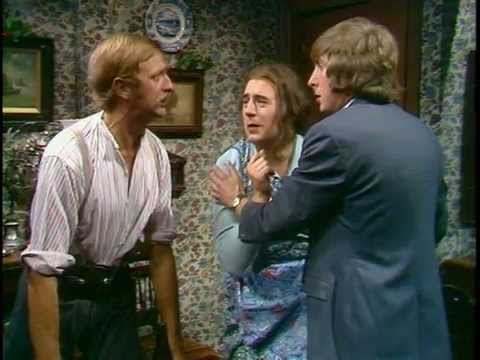
Monty Python's Flying Circus once featured a skit in which a well-dressed, professional looking young man named Ken (Eric Idle) returns to the home of his parents, where he receives a warm welcome from his mother (Terry Jones), but hostility from his father (Graham Chapman). What starts out looking like a tale of a college boy coming home to his working-class parents is quickly turned on its head, as Ken is a coal miner, while his father is an award-winning playwright and novelist. "There's nowt wrong with gala luncheons, lad!" sneers the father. "I've had more gala luncheons than you've had hot dinners!" The father suffers an attack of writer's cramp and kicks his disgrace of a son out, and then--the punch line: "I think there's a play there!"
It's the blessing and the curse of writers to see 'the play there' in all kinds of situations. A few years back, while driving through a hurricane to pick the Magpie up at a friend's house, I watched a normally placid creek boil through a culvert, and I asked myself, "What if I couldn't get to the house to pick the Magpie up?" This question was followed by opposite, but equally compelling thoughts: "That would be horrible!" and "Ooh, that might make a good story!"
Since I was actually able to pick up the Magpie and get her home safely, it was a case of 'no harm, no foul' and I was able to let my imagination run wild over the scenario I had imagined. And it was a good story. But sometimes, it's not always 'no harm, no foul.' One of the first ideas I ever had, though one I did not see to completion, as I wasn't seriously writing then, came about after hearing about two different, but related stories: one was a radio interview with the director of the Southern Poverty Law Center about the rise of hate groups, and the other was a particularly chilling story of a midwestern militia group that was planning on killing a state trooper, then ambushing the funeral. Pretty horrible stuff, but potentially the basis of a good story (and one that keeps coming back to me).
At the end of last week, I learned that a local man, someone I know through the school system, someone who was the Catbird's track coach for two years in middle school, someone about whom I would say, "He's a good guy!" was accused of a pretty nasty crime. You don't want to believe it when it's someone you know, when it's someone you think of as "a good guy." Hoping that it was some kind of mistake or misunderstanding, I found the criminal complaint attached to an online story. Innocent until proven guilty, yes, but this seemed pretty damning, and disgusting. And yet.
And yet, even in all of that, I find that Monty Python punch line coming back to me. "I think there's a play there!" There is, of course. There's a story there, in this man's crime; in its impact on his family, on the community. There's also the story of the victims, and the detective who discovered it. I don't know if I'd ever use this local man's crime as the basis of a
story or not. It might never feel right, either due to the nature of the crime or because it's too
close to home, but the story's there, just as there's a story in pretty much everything we see around us: the mother and child at the bus stop. The old woman who meticulously rakes her lawn every morning. The fender bender at the gas station. There's a story there. In fact, there are myriad stories in every instance, it's just a matter of which part of it we choose to tell.
Showing posts with label ideas. Show all posts
Monday, December 10, 2018
Tuesday, December 22, 2015
Tuesday Take Two: The Mind of a Writer
Because I'm feeling better (though I'm still not sure I could say that I'm feeling well), and because I actually somewhat slept last night, and because I feel kind of bad about yet another post with a title like yesterday's, I figured I'd try this again.
A week ago, I had one of those great "Writer Moments." For those of you readers who are writers, you'll know exactly what I mean; for those of you who aren't, this is a little insight into how our brains (or at least my brain) work, and how ideas start.
The starting point was a story on the website "I Fucking Love Science" which recounted how a town in North Carolina rejected rezoning a parcel of land that would allow a solar installation, then later approved a moratorium on all solar projects. During the public comment portion of the town council, at least one resident expressed fears that the panels would "suck up all the energy from the sun." I kid you not.
My first reaction?
Entirely appropriate, if you ask me. Though we call solar energy a renewable resource, it really isn't that, because renewable would imply that there's a sort of draw down and recharge cycle involved, like a rechargeable battery. As far as anyone can tell, solar is really an unlimited resource--until the sun goes supernova or whatever it will do in five billion years. I suppose, however, it's wrong to assume everyone knows this (it's also wrong to assume the person who made this claim was entirely serious, and not just spouting off. To be fair to the people of that North Carolina town, most of the concerns were centered on economic impacts to the town, and the fear that this type of installation would stifle business and drive down property values. Wonder if they'd make those claims if it were an oil or gas industry looking to tap petroleum reserves under the town). Still, I can't help but wonder about the state of our country when people believe solar panels will deplete the sun. Which brings me to my second reaction, the Writer Reaction. As I pulled the trigger on posting Stevie to Facebook, I thought:
But what if it did?
What if solar panels really did deplete the sun? What if all of our Go Solar initiatives, all the rooftop panels and solar fields, what if they somehow did hasten the processes in the sun, dramatically shortening its life? It's got the makings of a good story, doesn't it? (Though it could be short: "Oh, my God!" Hero Scientist shot up from his chair, where he'd been poring over the results of the latest computer simulation. "Solar panels really do deplete the sun! I've got to warn everyone before it's too l--" THE END)
I love moments like that, even when I know they won't come to anything. I'm not a science fiction writer, after all, so I don't really see myself running with this. On the other hand, some of you might be, so consider this my Christmas gift to you. Feel free to take this idea and let 'er rip (and Agent Carrie may be tearing her hair out right now if she's reading this. "You can do this! You can do this!" But if I did this, it would probably take me four years to get it to her, by which time editors will be saying, "Well, it was entertaining, but I think the 'Solar panels deplete the sun' market is dead, so, what else ya got?"). Just do me one favor: If you get it published, toss me a mention in the acknowledgments, would you? Merry Christmas!
Other business
Speaking of Agent Carrie, it's time for another of her Query Critiques. Help a fellow writer out! I may actually have enough brain power to get over there now and offer up my own scintillating comments.
According to timeanddate.com, the Winter Solstice occurred (in my area) at 11:49 p.m.--yesterday. We will have nine hours, two minutes and sixteen seconds of daylight, almost exactly the same as yesterday. Tomorrow? Tomorrow will be about four seconds longer. Interestingly enough, the sun will continue to rise a little later each day until next week, when it will hold at 7:30 until the second week in January, but sunset will occur later each day. It is interesting that the worst weather we get occurs even as the length of day is increasing. Forecasters are all calling for a warmer, drier winter here in the northeast due to El NiƱo; we'll see if that holds up.
Being sick and fitful sleeping gave me some bizarre dreams this week. One of the strangest occurred this morning. In short (and it was a short dream), I was out in my front yard and I noticed two or three unfamiliar, white-trash muscle cars in my driveway. I walked over. In the back of one sat a sullen young lady. I said, "Can I help you?" She said, "Stop calling my fucking phone." I asked what her phone number was and she told me, and then they left, and all I could think was, "I've never called that number." How bizarre.
That's it, Merry Christmas, thanks for reading!
Monday, December 7, 2015
The Big Fear (About Writing, that is)
On the first Wednesday of each month, many writer-bloggers participate in the "Insecure Writer's Support Group," an opportunity to share insecurities and fears with sympathetic souls and offer encouragement to others. I learned about this great idea early in my blogging life, but declined to participate. Not because I don't have insecurities, but because I have a hard enough time sticking to a schedule. And, what if, on the appointed day of the month, I wasn't feeling especially insecure? Or what if I was feeling especially insecure on the second Tuesday instead? So I sit it out, except as a reader and commenter.
Which is not to say I don't feel insecure about writing. Of course I do. I worry that no one will like it. I worry that people will read it and think, "What's wrong with that guy?" I worry that I'll never get published, or that if I do, no one will notice. But what worries me more than anything? That I'll run out of ideas.
To me, running out of ideas while still having the desire to write would be as horrible as watching a favorite athlete take the field when it's clear that his body is no longer up to what his heart and mind wants. It's one thing to wake up one day and say, "Meh, I don't feel like doing this anymore"--if that happens, it won't matter because I won't care, right? But without ideas?
And here's the thing for me: I'm not a big idea guy. I see people all over the internet talking about how ideas are "a dime a dozen." Even today, over at PubCrawl, Jodi Meadows states "You're a writer. You have lots of ideas." Guess what? I don't. While I do have a document on my computer called "Ideas" (very original, eh?), it's not an especially long document. And I don't know that I've ever actually gone back to it and pulled something from it and started working on it. I'm also not the sort of writer who generally has so many ideas in his head that he's not sure which to work on at any given time, or who works on all six (or ten, or twenty-five) all at the same time. As I've said before, ideas for me are things that develop slowly, over time, with multiple inputs that coalesce at just the right time. In the past, these ideas have hit just when I've needed them, just at the point where I've either finished or been close to finishing one project. Maybe my subconscious deliberately keeps things trapped in the back room until it determines there's going to be enough front room space to deal with it. The fear is that I'll get done with a project and then...nothing.
I am glad to say that the back room hasn't stopped working just yet. Though I'm still wrestling my current bear (and actually getting closer to jamming it into its cage), and have a year-old idea I'd like to work on at some point, a new idea came stumbling out of the back room last week. As is typically the case for me, it started with a question, and my question now is, "Could this be The Next One?" We'll see. I still have that other fat fish to fry first (cheers for alliteration!), but at least the ideas are still coming. Have a great week, everyone.
How about you--do you have a lot of ideas kicking around at a time?
NOTE: It's not posted yet, but since Carrie put out the call last week for submissions to her Query Critique, she might be posting the query today. Keep an eye on her blog and help a fellow writer out!
Friday, June 20, 2014
Phrase Nerd Friday: Drinking the Kool-Aid
"I'm not drinking anymore of Lou's Kool-Aid."--Mike Danton
Mike Danton was just a rookie when he uttered this phrase some time in 2002. He had played all of three games or so with the New Jersey Devils, suffered an injury, then refused assignment to the minor leagues, preferring instead to sit around and do nothing. Lou was (still is, in fact) Lou Lamoriello, New Jersey's General Manager. When Danton uttered this phrase, it was the first time I remember hearing it, but I knew exactly what he meant: he wasn't going to blindly accept and follow Lou's word, he was going to think for himself.
Since then I've heard "drink the Kool-Aid"--and used it myself--dozens of times, to the point where I've practically stopped thinking about it. Recently, someone said it and I thought about it--really thought about it--for the first time in a long time. "Drink the Kool-Aid" has long been in mainstream use, but I wonder how many people now know where it came from. I'm old enough to remember, and I think it's good to be reminded of it once in a while.
On November 18, 1978, 909 members of the Peoples Temple Agricultural Project died in a mass suicide/murder in Jonestown, Guyana. The Peoples Temple was a religious group led by the Reverend Jim Jones, who moved his flock to Guyana in the mid 1970s to form a 'socialist paradise.' Whatever the original goals and intentions of the temple, things started to unravel as Jones' mental health deteriorated. Temple members practiced various scenarios should the CIA or other forces storm the compound, including mass suicide.
With hints of abuse and mistreatment of members filtering out, California Congressman Leo Ryan flew to Jonestown to investigate. Ryan and four members of his party died when they were ambushed at an airstrip while attempting to return to the United States. Later that night, the murder/suicide occurred. Most people willingly drank paper cups filled with powdered drink mix (it was widely reported to be Kool-Aid; however, it may have actually been Flavor Aid, or a mix of the two) and cyanide. Those who could not or would not drink it, such as infants, received it orally via syringe. Others may have received a subcutaneous injection. Jones himself died of a self-inflicted gunshot wound to the head.
Well, that's a cheerful story for the day, isn't it? Again, I think it's good to once in a while think about where these phrases come from. "Jump the shark" is much more cheerful, isn't it? Have good weekend, all.
Friday, December 13, 2013
"Sticky" Books
My friend, Nancy S. Thompson, challenged me on Facebook the other day. The challenge? Name ten books that have stayed with me through the years, without overthinking.
Of course, I'm not big on doing this sort of thing on Facebook. To me, Facebook is best used for posting funny pictures, and sitting back and making witty comments on other people's posts. Also, I am big on overthinking, so to the blog it goes. Here's my list, which will not make it to ten. These are in no particular order, except maybe the first one:
1. Salem's Lot, Stephen King. I read this when I was about ten years old, a critical time in my life when I was stepping into that nether world between 'kid' and 'teen'. It didn't exactly make me say "I want to be a writer when I grow up!" but it was part of the fuel that burned so brightly when my sixth grade teacher struck a particular spark a few months later. King in general has been a huge influence on me, and this was the one that started it for me. It's still my favorite vampire book.
2. A Prayer for Owen Meany, John Irving. This one may actually be my favorite book of all-time, and I'm not good at picking favorites of anything! It's definitely my favorite Irving book. It's a great story full of unique characters, and Irving hadn't quite gotten so hung up on delivering lectures in literature yet. The book is thought-provoking, frequently funny, and still makes me tear up. There, I admitted it.
3. Ever Since Darwin, Stephen Jay Gould. I first 'discovered' Gould while leafing through Natural History magazines at a summer job. When the new issues would come in, the first thing I went to was Gould's column, This View of Life. Gould was a brilliant scientist who wrote about science, evolution, Darwin, and life. He did this in a way that was intelligent without being pretentious, and never talked down to his audience. Gould's essays could seem to wander off topic, yet he always wrote with a point, and those things that seemed to have nothing to do with the topic at hand always made sense in the end. He was a writer I very much admired, and very much wanted to be like.
4. Arctic Dreams, Barry Lopez. Someone loaned me this book many years ago and I loved it so much, I had to buy it myself. This is a beautifully-written account of an inhospitable (for many of us) world, an excellent account of its people and its wildlife, and how land and climate shapes life. This is the sort of writing I aspire to, but, sadly, don't reach.
5. Hamlet, William Shakespeare. It's got everything you want in literature--Great language! Humor! Treachery! Revenge! Hamlet is one of the most maddening characters in literature--you want to grab him by his tunic and slap him around and yell, "Stop dithering and get on with it already!" You want to run him through for what he does to the hapless Ophelia, not to mention the ill-fated Rosencrantz and Guildenstern. Yet that maddening element of his personality--his inability to make up his mind when face with a huge decision--is what makes him relatable. After all, killing a king is not something you should rush into. Sadly, his desire to be certain leads to a pretty big body count of (mostly) innocent victims. My favorite Shakespeare.
OK, I'm done, well short of ten, but that's okay. Now, I had considered trying to turn this into a meme or whatever, but I'm too lazy for that, and I don't want to burden anyone by tagging them. So I'll ask: How about you? What books have stuck with you through the years? Feel free to list them below, or make your own post (and link it in the comments). Have a great weekend, all!
Monday, July 8, 2013
A Lesson From Looper
Last weekend, I finally got to see the movie, Looper.
This was a movie I wanted to see from the instant last summer I saw the teaser on television (and this will tell you what's on my mind lately: when I wrote that line, I wrote 'query' instead of trailer).
The concept is fantastic. Men recruited in the present (which itself is about thirty years in our future) to assassinate men from the further future. The targets arrive at a predetermined time and location, where the 'loopers' (killers) shoot them and dispose of the body. At some point, however, the loopers themselves are deemed unnecessary, and you get to kill your future self. Mind blown.
Time travel stuff fascinates me, but it also has the potential to overwhelm a story, and can lead to all kinds of complications. I suspect J.K. Rowling may have gotten rid of the Time Turner from the Harry Potter series after finding herself with a device that could have been too powerful, too complicated to explain, and too easy to use as a way to get Harry and company in (and especially out) of trouble.
But here's how they dealt with time travel in Looper:
Hah. I love it. The movie just presents time travel as an established fact and ignores trying to explain how it actually works. The simple truth is, none of the characters need to know how it works, thus we don't need to know how it works, either. And instead of getting lost in all that wibbly-wobbly, timey-wimey stuff, we can focus on the story, which is really NOT about time travel. Well played, Rian Johnson. Well played, indeed.
This was a movie I wanted to see from the instant last summer I saw the teaser on television (and this will tell you what's on my mind lately: when I wrote that line, I wrote 'query' instead of trailer).
The concept is fantastic. Men recruited in the present (which itself is about thirty years in our future) to assassinate men from the further future. The targets arrive at a predetermined time and location, where the 'loopers' (killers) shoot them and dispose of the body. At some point, however, the loopers themselves are deemed unnecessary, and you get to kill your future self. Mind blown.
Time travel stuff fascinates me, but it also has the potential to overwhelm a story, and can lead to all kinds of complications. I suspect J.K. Rowling may have gotten rid of the Time Turner from the Harry Potter series after finding herself with a device that could have been too powerful, too complicated to explain, and too easy to use as a way to get Harry and company in (and especially out) of trouble.
But here's how they dealt with time travel in Looper:
Abe (the man sent back in time by organized crime to run the Loopers): "All this time travel crap, it fries your brain like an egg."
Old Joe: "I don't want to talk about time travel because if we start talking about it then we're going to be here all day talking about it, making diagrams with straws."
Hah. I love it. The movie just presents time travel as an established fact and ignores trying to explain how it actually works. The simple truth is, none of the characters need to know how it works, thus we don't need to know how it works, either. And instead of getting lost in all that wibbly-wobbly, timey-wimey stuff, we can focus on the story, which is really NOT about time travel. Well played, Rian Johnson. Well played, indeed.
Friday, June 21, 2013
50 Ways....
Remember that old Paul Simon song, 50 Ways To Leave
Your Lover? What's that, you don't? Oh, right, of course not, you're too young. Well, it
was a hit for Simon back in the mid-70s, which is why most of you DON'T remember it, but through the magic of the internet, you can see it here, if you so choose.
One person who probably does remember it is Hall of Fame broadcaster,
Mike "Doc" Emrick, the current voice of the National Hockey League
during the Stanley Cup Final. While he's not everyone's cup of tea, I've loved listening to Emrick since I first heard him calling games
for ESPN back in the 90s. His love of the game is evident, and
he's one of the most creative souls when it comes to describing the action.
Case in point: during Game 1 of the final between Chicago
and Boston last week, Doc used no
less than fifty (50!) words to describe a simple action that takes place
hundreds of time during a game: the movement of the puck from one player to
another, which is typically called "a pass." Someone kept a list, and here it is:
As outlandish as many of Doc's synonyms look on paper, they are frequently bang-on
descriptions for the action. While I'm not entirely sure how you 'wand' a
frozen disc of rubber, and 'spirits it' is a total head-scratcher, most of these
really, really work in the course of the action. And this list is not inclusive; this is only what he used in game 1. Doc also has players 'shillelagh it' (knocking the puck out of the
air), and one of my personal favorites
is 'ladled it', which occurs when the puck is played softly down
the ice.
I'm not sure what's more amazing, the fact that
a) Doc
has actually come up with so many words to describe a common action;
b) Doc
can actually remember to use these words appropriately while in the midst of
describing what can be a ridiculously fast-paced game; or
c) Someone
actually sat down and made this list while the game was going on (I'm guessing
the guy had no rooting interest in the game)
Point B is something all of us writers should take into
consideration. We're always looking for new ways to say something, to set us apart from all the other writers out there. There are all kinds of interesting ways to say things, and it's our job to find them. BUT the key is to make the words sound natural, to fit them into the flow of our writing, to match them to the voices of our characters.
Oh, and of course, someone did a "Doc Emrick 50 Words Mashup", which is a fun listen. Enjoy, have a great weekend!
Friday, June 14, 2013
Selling Fun
"Never forget, we sell fun."
That quote comes from a character in Joyland, Stephen King's most recent book. Released earlier this month, the book is notable in part because King has
decided not to release it as in print only, at least for now. That decision is actually the subject
for another post, another day. No promises, though.
AT any rate, in an interview for Parade magazine, King had
this to say: “The major job is still to entertain people. Joyland
really took off for me when the old guy who owns the place says, ‘Never forget,
we sell fun.’ That’s what we’re supposed to do—writers, filmmakers, all of us.
That's why they let us stay in the playground."
'Fun' is
such a strange word. The implication of 'fun' is…well, fun. Laughing. Smiling. Happy
sounds and warm feelings. Tigger is fun. Clueless Pooh (or accidental genius
Pooh) is fun. Fun can even be a book that is somewhat unpleasant but has that
"Holy crap, I never saw that coming!" moment. Think Gone Girl (or most anything by Gillian Flynn, come to think of it). As long as the twist doesn't
feel like a cheat, it's usually pretty damn fun. But if there's no twist? If
you're dealing with straight up tension? Is that fun?
Thinking of movies for a moment, I can't say that The Exorcist was 'fun.' I was about 7 or 8 when that movie came
out; just seeing the commercials on TV scared me, and Tubular Bells still gives me the
shivers. When I finally saw the film, it scared the hell out of me, and
though I was past the age for movie-induced nightmares, I still got 'em. Fun? Maybe, maybe not, but it was one hell of a good movie.
![]() |
| Fun or fright? Kind of hard to tell |
The good thing is, there's room for all of it.
Have a great weekend, all.
Photo from Fellowship of the Rich.
Have a great weekend, all.
Photo from Fellowship of the Rich.
Monday, April 22, 2013
Little Brother Is Watching
Big Brother Is Watching You. Chances are you're familiar
with the phrase and its origins, even if you've never read George Orwell's 1984. And while we in American swear,
"It couldn't happen here," especially after the fall of the World's Largest
Totalitarian State,
the fact is it's easier than ever for Big Brother to keep tabs on us. We freely
hand out an astounding amount of personal information on a daily basis that
could theoretically be used by Big Brother to track our movements (E-Z
Passes, GPS
systems, credit card/ATM purchases, those annoying little "So-and-so was
at such-and-such with 3 other friends" on Facebook), our habits, our
interests. Even the simple act of purchasing a shirt at a department store
comes with a request by the cashier for our phone number or ZIP code, and would
you like to give me your e-mail so we can send you a coupon?
![]() |
| photo by Jorge Rodriguez-Gerada |
Those of us hoping to make a splash in the literary world
don't have to worry too much about Big Brother. Big Brother generally doesn't
give a rat's hinquarters how you make a living, provided a) it's not illegal,
and b) you give your fair share to Big Brother. Big Brother also doesn't really
care what you write in your books or what you say in an interview or on your
blog, unless you're advocating violent revolution or waving the flag for al-Qaeda
or Kim Jong-un. Mabye you'll find yourself on a watch list if you raise a stink
about bringing your tube of Preparation H on an airplane, but you'll probably
never know it, and it will probably never affect you in any real way. But Little
Brother is another story. Like Big Brother, Little Brother is always watching,
and Little Brother is much more willing to mess with you.
Who is Little Brother? I am. You are. Anyone with a camera
phone and access to Facebook, Instagram or Youtube. Anyone who blogs or Tweets
or is involved in a forum with a big audience, such as Goodreads. And since
you're reading this, and since most of you have blogs and such of your own,
that means probably about 99+% of the people you come into contact with on a
daily basis. Big Brother is a mostly-cold bureaucracy that grinds along,
following its own byzantine set of rules, regulations, and procedures. Little Brother, on the other hand, is
hot-blooded, passionate, and has no rules. Little Brother is capricious. If you offend Little Brother in some
small way, Little Brother will post the video, screen cap the blog post before
you can take it down, and amass a mob of other Little Brothers, all waving
virtual torches and pitchforks, and telling the rest of the world that they
will never buy one of your books again, ever.
Can Little Brother really hurt your writing career? That
remains to be seen. Perhaps it depends on what level you're at. Perhaps it
depends on what level of offense you've committed (and I should note, there are
times when Little Brother is perfectly justified in calling out Bad Author
Behavior, and times when Badly Behaving Authors deserve to be called out for
things they say and do). Perhaps it's really a case of 'there's no such thing
as bad publicity.' What I do know is we have to think before we speak,
reconsider before we hit the 'send' or 'post' button, and carefully consider
every word. That shouldn't be too hard; we're writers, after all. It's what we
do.
Note: I'm really not as paranoid as this post makes me appear, but I've seen enough authors getting raked over the coals in places lately that this has been on my mind quite a bit. As the duty sergeant (I think) used to say on the show, Hill Street Blues: "Be careful out there."
Friday, March 8, 2013
Dear Diary
We're having snow today, a decent storm that may or may not
close schools. I haven't ventured outside yet, but it looks to be around four
inches or so. A plow just came down our street, which now looks pretty clear,
as does the main road. So, although five districts in our county are currently
closed, and two are on a two-hour delay, I think we'll be 'business as usual'
today.
It's been a week of snow, a little each day. There's an old
phrase we learned as kids, "March comes in like a lion, goes out like a
lamb." It seems pretty accurate in a general way. Or, rather, it did when
I lived downstate. Up here, where we've been for ten years now (holy crap,
where did the time go?), March starts later and lasts longer. Lion weather
doesn't usually start up here until the middle of the month, and lamb weather
begins closer to the end of April, even the beginning of May. And even though
Punxsatawny Phil claims spring should be starting right about now, things don't
work quite the same way in central New York.
![]() |
| Didn't everyone have one of these? |
Lately, I've been kicking myself over not keeping a journal.
I don't know if this is something all kids go through, or if it was a
particular fad back in the *harrumph* when I was a kid, but I recall a time
when diaries were the 'in' thing. My brother, my sister and I all got diaries
one Christmas, and it WAS SO COOL! You know the kind: faux leather cover, 'My
Diary' stamped on the front in gold, little leather strap, flimsy lock,
flimsier key attached with a red string. Inside, lined pages (undated, I think)
waiting to be filled with important thoughts, observations, or…nothing. As a
seven or eight-year-old, or whatever I was, I lacked the drive and discipline
to keep a diary. I vaguely remember making brotherly attempts to break into my
sister's diary, but I don't think we succeeded. I think we successfully stole
it once or twice, but never actually broke into it. Maybe we had too much
respect for her. I'd like to believe that, though it's more likely we feared
the wrath of Mom, should she get involved.
Somewhere along the line, diaries became things for girls.
Guys didn't keep diaries. There was something…unmanly…about it. Diaries were
out, but journals? Those were okay. Don't ask me why. The word implies
something more clinical, less personal. Journals are about recording
observations and facts, not feelings. Lewis and Clark kept journals. Theodore
Roosevelt kept a journal. Many of the great scientists kept journals. Journals
were okay, for guys. Diaries were out.
I've made a few stabs over the years at keeping journals; it
appeals to the part of me that admires the great naturalist-artist of the 18th
century, men like Audubon and Fuertes and Darwin. I never keep up with it,
though. I'll get a day or two into it, and then forget. I started again last
week, with a short paragraph noting the weather. Snow and cold. Fifteen wild
turkeys in the field. That sort of thing. It can be handy if you keep up with
it. Some years down the road, when I'm old and cranky and want to prove
definitively that, "This winter ain't nothing! You ought to have been
around back in '15!" I'll be able to find the journal and go through it
and see what the winter of '15 was really like. And who knows? Maybe it can be
something that can help write a book.
Do you keep a journal or diary? Have you ever used it in
your writing?
Big congratulations to Carrie Butler, whose new, New Adult novel,
Strength, hit the streets yesterday!
Monday, March 4, 2013
A Pen Post
I'm feeling a heck of a lot better than I did last week. I've left the house a few times (more important, I felt the need for a shower. Though I still can't smell myself, I couldn't run the risk of anyone else smelling me), including going to my writer's group yesterday. Physically, I'm feeling pretty good; mentally, I'm still not 100%.
Yesterday was a 'pen day' for me in my writer's group. I can't remember if I've written about this phenomenon here before or not, and I can't quite force myself through nearly 200 posts to find out. What's a 'pen day', you ask? It's a day where I spend 3/4 of our free writing time struggling for an idea, or maybe there's a hint of an idea that I can't really catch hold of. The page is full of half-sentences and scribbles, and then, with a few minutes left, I start writing about...my pen. No, this is not a badly-disguised euphemism.
I've written at times about the sound my pen makes, I've written about what must be happening to the paper as the fine point rips across it, I've written about the way the pen feels in my hand. I've had a bunch of 'pen days' in my writer's group, though not in a while. Yesterday I wrote about how I lost my pen. I'm very particular about pens, and I really like this particular type. I took it with me in the even I was moved to write while waiting for the Catbird to get done with a school function, but it never got where I was going. It wasn't in my pocket or the car, it wasn't in the house. My conclusion was it slipped off the cover of my notebook and was lost--forever.
Two days later, I saw a silver gleam in the mud when I was backing my car out of the driveway. Yep, it was the pen, and yes, I had run it over. Possibly more than once. The barrel was in fragments, but the cartridge was intact. Fortunately for me, the Catbird is a notorious collector, and she had one of my expired pens saved up for...I don't even know what. I performed a cartridge transplant, and still have a working pen.
Anyway, I wove this story of my pen around a story of the time, some fifteen(!) years ago, I ran over a pack of my wife's cigarettes in a convenience store parking lot. The smokes, freshly bought, fell out of my pocket. I ran them over. The box was slightly dented, but the cigarettes survived.
The story made people laugh. It didn't really get me anywhere. If I had started writing the pen story right away, however, I might have ended up with the basis of a new novel, a usable short story, a revision for an existing work, or maybe even a blog post. The point, though, is there's always something to write about. We have limited time to write, and it can be maddening when the words don't come out the way you want. If you're stuck, write about your pen. Or your keyboard. Or the coffee stains on your shirt. Or your half-awake stumbling to the shower. Chances are good that the act of writing, even if it's not what you want to be writing, will get you going enough. Yeah, I've definitely written this sort of stuff before, so my apologies if it feels like a rerun. I suppose it's good to be reminded of it every once in a while, right?
Meanwhile, by now you've probably seen Amanda Palmer's TED Talks appearance that's taking the world by storm. I can't connect all the dots today, my brain is too addled by illness and ideas, but I've certainly been thinking about it. Go watch it if you haven't already, let it stew. Some day, maybe we'll talk about it here.
And, finally, congrats to Carrie Butler, whose novel, Strength, debuts this week. Carrie will be here for an interview on 3/15. Looking forward to it! See you all soon.
![]() |
| You know it's a bad day when I write about my pen! |
I've written at times about the sound my pen makes, I've written about what must be happening to the paper as the fine point rips across it, I've written about the way the pen feels in my hand. I've had a bunch of 'pen days' in my writer's group, though not in a while. Yesterday I wrote about how I lost my pen. I'm very particular about pens, and I really like this particular type. I took it with me in the even I was moved to write while waiting for the Catbird to get done with a school function, but it never got where I was going. It wasn't in my pocket or the car, it wasn't in the house. My conclusion was it slipped off the cover of my notebook and was lost--forever.
Two days later, I saw a silver gleam in the mud when I was backing my car out of the driveway. Yep, it was the pen, and yes, I had run it over. Possibly more than once. The barrel was in fragments, but the cartridge was intact. Fortunately for me, the Catbird is a notorious collector, and she had one of my expired pens saved up for...I don't even know what. I performed a cartridge transplant, and still have a working pen.
Anyway, I wove this story of my pen around a story of the time, some fifteen(!) years ago, I ran over a pack of my wife's cigarettes in a convenience store parking lot. The smokes, freshly bought, fell out of my pocket. I ran them over. The box was slightly dented, but the cigarettes survived.
The story made people laugh. It didn't really get me anywhere. If I had started writing the pen story right away, however, I might have ended up with the basis of a new novel, a usable short story, a revision for an existing work, or maybe even a blog post. The point, though, is there's always something to write about. We have limited time to write, and it can be maddening when the words don't come out the way you want. If you're stuck, write about your pen. Or your keyboard. Or the coffee stains on your shirt. Or your half-awake stumbling to the shower. Chances are good that the act of writing, even if it's not what you want to be writing, will get you going enough. Yeah, I've definitely written this sort of stuff before, so my apologies if it feels like a rerun. I suppose it's good to be reminded of it every once in a while, right?
Meanwhile, by now you've probably seen Amanda Palmer's TED Talks appearance that's taking the world by storm. I can't connect all the dots today, my brain is too addled by illness and ideas, but I've certainly been thinking about it. Go watch it if you haven't already, let it stew. Some day, maybe we'll talk about it here.
And, finally, congrats to Carrie Butler, whose novel, Strength, debuts this week. Carrie will be here for an interview on 3/15. Looking forward to it! See you all soon.
Friday, February 22, 2013
'Write the Story You Want to Read'
When I started 'head writing' my guest post for Bonnee last week, I thought I was going to end up with something different than what she
asked for. It started shading from 'why I write' to 'why I write what I write',
but once I started really writing the
post, I worked my way back to the original question. Sometimes things work out
the way they're supposed to. Still, the the proverbial pump had been primed,
and I was thinking a lot about why I write what I write.
A long time ago, I wrote a post about how ideas for me are
usually the result of not one instantaneous blast of inspiration, but of several
smaller 'mini-blasts' that kind of build on each other and make something
bigger. Some weeks back I was reading a query letter on AW's query letter hell
(the 'be brave' post came out of that one). Something in an exchange I had with
the author got filed away in my brain for later use. So did a couple of other
queries I've come across recently. Add in the thinking over the guest post for
Bonnee, and things were starting to happen in the back room. Finally, while
reading Catching Fire this past
weekend, it all came together, and I had a new found understanding of the writer's
proverb (adage? Aphorism?), Write the story you want to read.
It's a little embarrassing to admit, but when I first
started hearing this I often thought, "What the hell does that mean? I
don't know what I want to write." I'm usually pretty good at sifting
through all the advice thrown at writers. I've known from the get-go that
'start with action,' for example, doesn't mean car chases and explosions, that
'never use adverbs' really means 'use adverbs as needed,' and 'show don't tell'
should be followed by 'when appropriate.' Yet 'write the story you want to
read' kind of mystified me.
The problem, as I have now learned, is I was taking this
advice far too literally. The truth is I don't think there is any particular story
burning a hole in my head like cash in a gambler's pocket. I haven't been
walking around for years thinking, "Damn, if only someone would write
about an all-male burlesque show set on Saturn in 2145!" Nothing I've
written so far is the result of yearning for *this* story or *that* one.
Instead, I was fortunate enough to have a character or situation or scene kick
open the door from the back room and say, "Here I am!" and that's
been enough to start. The rest of the story comes along once I start writing. It
doesn't always end up coming out the way I thought it might, but it comes out,
and it's right—for me.
![]() |
| © Copyright Andy Beecroft. Licensed for reuse |
But I digress. The 'aha moment'—the moment when the stuff
from the back room kicked open the door and fused instantly with the stuff in
the front room—occurred while I was 30 pages or so into Catching Fire and found
myself at a fork in the road. In one direction was the story as written, though
I didn't know what that was just yet (I didn't read any flap copy, I just
grabbed the book). It turned out okay. I read the book in about a day, it kept
me turning pages, yes, and I will read Mockingjay just to see how this
finishes, but I wasn't thrilled. It wasn't bad, but it wasn't great, either. I
think most of my disappointment was because of what I saw down that other fork.
Briefest of spoilers here, and I will say, this caught me by
surprise in the book: Katniss and Peeta end up back in special edition Hunger
Games, sort of like the Survivor All-Stars. As I said, it worked out pretty
well as a book, but what I saw down that other fork was this: Katniss living in
District 12, having to deal with the consequences of her actions from the first
book (yes, true, going back in the games was a consequence of book 1, it was just a different consequence). Those consequences included things like dealing with her new-found fame
and fortune, coping with the memories of her experience in the Games, having to
deal with the way she is viewed by the people back home, which would likely be
a mix of reverence, envy, and, possibly, fear (imagine seeing your friend legally
kill several somebodies on live TV in brutal and clever ways, and then trying
to have a normal conversation with them. Freaky, huh?). I wanted something that
really dug into Katniss's character, that delved deep to examine the impact of
the first book's events on her life and relationships to the people and world
around her. I didn't get it, and I was disappointed, until I shifted my
expectations a bit.
I found myself thinking a bit about what I might have done,
the story I wanted to see, and that was when the notion of 'write the story you
want to read' really hit me. For me, for now, it's about stuff that goes on
sort of below the plot layer. It's about characters and why they do the things
they do. Plot is important, yes, but I like fiction that really focuses on
characters and how they grow and change (or don't) over the course of a book.
That's what I want to read. That's what I like to write. It's funny that I
never thought of it that way before.
Monday, February 18, 2013
Monday Musing
Hey, all, not much on my mind today, still recovering from the whirlwind week of traveling. Thanks to Bonnee Crawford for hosting me on Thursday or Friday last week; my guest post--Why I Write--is still there for your viewing pleasure.
It's funny how ideas spawn ideas. When I first started head-drafting my guest post for Bonnee, I saw it going in a different direction than what Bonnee asked. I wasn't sure I could really answer her question. Why do I write? Who knows? But when I started going from 'head draft' to 'virtual paper draft' I found myself veering away from what I thought I was going to write and ending up more or less answering the question. I also left myself with a potential follow-up post, which this isn't, not exactly.
After finishing the post for Bonnee and basking in the glow of my First Guest Post Ever! I found myself reading Catching Fire, which is book 2 in The Hunger Games trilogy. I enjoyed The Hunger Games quite a bit back when I read it, but knew better than to devour all three books in too short a time period. Time got away from me, and here I was, more than a year later, finally getting back to it. During a point early in the book I found myself reading a passage and thinking, "Yes! Go there! That's what I want to see!" I could see the book developing in a particular way, and I really wanted it to happen. But Suzanne Collins did not 'go there.' She took the book in a different direction, one that was right for her. I'm not going to get into any review of the book. I enjoyed it well enough, though I definitely liked book 1 better.
But between reading Catching Fire, working on Bonnee's post, and some things I had seen in Absolute Write's Query Letter Hell section over the last couple of months, I had one of those "Ah ha!" moments, the golden moment where something suddenly becomes crystal clear to me. You ever see anyone say, "Write the story you want to read"? Yeah, it's one of those pieces of writing advice that's thrown around with great frequency, and it's one of the pieces of advice that has just never clicked into place for me. Until that moment.
This is not to say I haven't been following this advice over the last few years I've been seriously writing, but it came through in that moment with a clarity that it hadn't before. That's all I'm going to say on the topic for right now. I'm going to have to busy myself organizing my thoughts coherently enough to follow up on this on Friday, but that's my aim. In the meantime, have a pleasant week!
Monday, December 17, 2012
Sucky First Drafts
It is a truth universally acknowledged, that the first draft
of anything sucks.* This 'truth' is a great comfort to writers who read their
first drafts and want to tear their hair out. "Oh, this sucks!" they
scream, while dragging their poor monitor to the window, as if it's the
monitor's fault. But then they take to a writer's forum to bemoan the horrible
state of their first draft, and someone points out this truth, and they feel
better, and press on.
It's liberating, being allowed to suck. It allows one to
proceed with some degree of confidence. 'If shitty first drafts were good
enough for Hemingway,' we think, 'they're good enough for me!'
As I read a thread over the course of the weekend, however,
something started gnawing at my insides. A feeling that some are starting to
take to this 'truth' and turn it into a Truth, or that they're looking at it as—dare
I say it?—another rule.
But remember this: Just because the first draft is allowed
to suck, doesn't mean it's supposed to suck.
What I mean here is, if you draft at all like me, then
much of your draft will, in fact, suck. I'm a brain dumper. In my head is a slippery,
slimy story scampering around in the dark. It's hard to see all of it. It's
quick and elusive. Drafting, for me, is the act of dumping that thing out into
the bright light where I can pin it down and examine it. That first draft is full of typos, awkward sentences, and needless repetition. I'll repeat,
almost verbatim, the same paragraph in three different places, because I'm
desperately trying to communicate a particular idea or theme. Once this thing
is on the page and has stopped moving around so much, I'm looking for things
that don't suck: believable characters, a compelling plot, authentic dialogue.
The prose itself can suck, but these things have to be sufficiently non-sucky
to convince me to go on to the next phase, the (hopefully) Quality Wordsmithing
phase.
So, I guess if there's any advice in here, it's allow that 'truth'
to grant you freedom to write without too much worry, but make sure you've got
something good in there.
Looking forward to Friday, when I'll have Lisa L. Regan here—see
you then!
*Apologies to Jane Austen. And Hemingway's quote is, "The first draft of anything is shit."
Monday, September 3, 2012
Musical Monday: Your Racist Friend
The Magpie has been in touch with one of her friends from home, a girl I'll call the Robin. The Robin is an outgoing, cheerful young lady, all Rainbows and Unicorns, who evidently got socked with her own case of The Second Week Blues at her college. She also had an experience that made me think of this great song from They Might Be Giants (3 minutes, no video so to speak):
The Robin has been having a bit of trouble finding her way at her college, it seems. Stuck with a roommate who alternates between niceness and not, and being in the unusual position of not really connecting with anyone, she's a little desperate to make friends, but at least it seems like her decision-making is good, as we shall see.
The Robin recently spied a fellow who made an unusual sartorial decision: he sported a bow tie with a pair of suspenders. An odd choice for a teenager, but the Robin took a chance; she approached, and opened with the conversational gambit, "Bow ties are cool."
Her guess was correct: the young man was a Whovian, i.e., a fan of Doctor Who, and she found someone to nerd out with. She must have been ecstatic, must have felt as if she was finally connecting with someone, that maybe she was in the process of building a potential friend. Finally. Rainbows and Unicorns are back!
And then the conversation continued, and the rainbows and unicorns became rainstorms and minotaurs.
According to the Magpie, as the Robin continued her conversation with her fellow Whovian, it became increasingly clear he was, in fact, racist. We didn't hear all the details,and I won't repeat the particularly egregious thing he said as relayed to us,
but it was a doozy. The Robin even tried to give the guy some room to wiggle out and show himself to be better than that. He made a rather broad statement, to which she said, "In YOUR
experience?" Nope. He was not basing his beliefs on any direct experience of his own. If he had, then perhaps he could have been argued with; perhaps he could have seen that her direct experiences undermined his beliefs. Maybe he could have seen her point of view, and been more willing to change his own. Instead, he was merely parroting some belief that came to him from
somewhere. I'm not one for blaming parents for everything (as a parent, I can't afford to do that, hah hah), but I believe that's where most of these beliefs come from. At any rate, that was enough for the Robin. She told him off and walked away,
upset and angry, still friendless, but better off in this case.
"Everyone's a little bit racist," sing the puppets
in the musical, Avenue Q, and I suppose there's a grain of truth to it (and I grudgingly admit it exists in me, too, though I do my best to work past it and stamp it out). Not to use biology as an excuse for abhorrent behavior, but maybe there's some deep-seated survival instinct that makes us inherently mistrust people who look or act differently that we do. Or maybe it's purely society that's done it, I don't know. I do know it's better than when I was a kid, and it's certainly better than 50, 60, or 100 years ago. Sadly, it's still out there, and it's especially disappointing to hear coming from one so young.
Friday, July 13, 2012
Confession: Inner Space Interview
"I was sitting here...replaying the incident over in my head when I had what alcoholics refer to as a moment of clarity."--Jules Winnfield
Man, this is going to sound weird. You're all going to think I'm a total nut job, as if my anti-techno rants don't already have you thinking that way. But what the heck.
Many professional athletes today practice 'visualizing'. It can be something as simple as picturing themselves victorious, or can be far more complex. A relief pitcher might see himself coming into the game in the ninth inning with two outs, runners on the corners, and the BIG KAHUNA at the plate. He'll envision the sequence, pitch by pitch, of getting the guy out. A goalie might see the opposing team on the power play. He follows imaginary pucks as the other team works it from D to D, from high to low, tries to go for the back-door play. A quarterback sees the blitz on third and long and is prepared to hit his hot receiver. You get the idea.
When I was a kid I'd 'visualize' all the time, only back then we called it 'imagining.' A favorite at a certain age was pretending the street was lava. I'd balance on the curb, and I'd see the road, not as solid black pavement, but as a viscous, bubbling red-and-yellow river that would burn me to a cinder if I so much as dipped a toe in it. I also saw myself hitting the grand slam in the bottom of the ninth inning or scoring the Stanley Cup-winning goal in game 7 (overtime, of course; after scoring to tie the game in the last minute, too). Nothing unusual in any of this for a kid, I suppose.
I still imagine, and, as just about everyone who visits here is some kind of writer, I imagine you do, too. Only now, the dreams have changed. Now I visualize myself at author events, standing in front of an enraptured audience while I read an excerpt from my latest masterpiece. I have conversations with agents and editors, or get interviewd on something like Off the Page. Totally dorky, I know, and rather embarrassing to admit it, but visualizing positive results supposedly works for some people (honestly, it can be a good way to psyche yourself up or motivate yourself). Athletes use it both to calm down and prepare for any situation that might arise in a game. For me, it's always been more of a fun little fantasy, though I do think about the questions I'll ask and the answers I'll give when I get THE CALL from Dream Agent, even though I know I'll end up a fumbling, stuttering mess, with my face as red and hot as the lava I used to visualize in the street, and I'll forget half of what I wanted to say or ask.
Like I said, it's kind of dorky. But sometimes it pays off.
Yesterday I had to run some errands in town. It's a ten-minute drive there, a ten-minute drive home, and, given that this is tourist season, a twenty minute search for a parking space. Driving time is great for
In the interview, I was talking about what the book was about—not a simple plot summary, but what it's really about, the real theme of the work. As the words unspooled in my head, as imaginary me talked about a book the real, unagented, unpublished me hasn't really finished yet, everything became crystal clear. Future me totally nailed it. Better still, the Inner Space Interview segued very naturally into a piece that I knew had to go in the manuscript itself. Good thing I was on my way home at the time. When I got home I ran straight to my desk, popped my headphones on, turned up the music and got down to writing.
It's not like I didn't know what Barton's Women is about—I've known from very early on in the writing process, but I also know I was missing something, the 'what's it all about' was not entirely there. I was circling around it like a mosquito coming in for a landing, and I had most of it, but I didn't have all of it, and I think that's part of what led to my desperate call for a WiP Whip. The manuscript grew bigger and bigger because I was trying to write myself into something, because I was searching for that one element that eluded me. Kind of funny that I found it through daydreaming (err, visualization), but maybe not: I've been making a revising run on Barton's Women these last two weeks, which has engaged the planning/plotting/active thought part of my brain. Sometimes, the way to find something is to stop looking for it. My Inner Space Interview shifted me back into Discovery Mode, and I found what was missing. We'll see what happens today when I try to reshape the sloppy mass of clay I threw out on paper yesterday, heh heh.
And now that creepy confession time is over, here's a bit of fun from someone else with an active imagination, Rachel Bloom. An appropriate tune for a Friday, since she definitely mocks Rebecca Black's Friday just a little bit. Oh, and if you're familiar with some of Ms. Bloom's other work, this one is mostly safe for work, family, children, etc. Visit her other songs at your own risk. Have a great weekend, all.
Friday, June 22, 2012
The Book of the Future
"Can it core a apple?""Oh, it can core a apple!"
Those lines come from a classic episode of The Honeymooners
titled "Better Living Through TV." In it, Ralph buys time
during a movie broadcast and appears as The Chef of the
Future, presenting a tool—The Handy Housewife Helper—that will revolutionize
the kitchen, a tool that will "do the work of all these old-fashioned gadgets." I thought of this earlier in the week when Nathan Bransford (you
do read Nathan, don't you?) speculated on The Book of the Future.
Nathan compared the Book of the Future to the introduction
of color to motion pictures in the 1920s and 30s. Once used as a 'special
effect', color has become the default for movies and TV. If you're using
B&W, you'd better have a damn good reason. Nathan wonders if a similar
revolution is occurring with books. The technology exists, he points out, for
books to be "colorful, interactive, three-dimensional. Imagine," he
goes on, "the ease of a hyperlinked choose your own adventure novel or
instructional videos within a cookbook."
It sounds fun. Marrying technologies to produce a true
multi-media experience is not necessarily a bad thing. Imagine having your
Chilton manual on a tablet with a 3-D image of your car's engine so you can
really see where that cotter pin is, and being able to rotate the image and
zoom in on it, for example. Or being able to see on video the moment your egg
whites turn to meringue (though my own limited experience with this is you
really do need to go by feel, not by look). For fiction, maybe there's some way
to have a truly interactive experience with your book wherein you get to guess
the identity of the jewel thief or the mysterious lover. There are a lot of possibilities. Sony's Wonderbook seems pretty cool, but right now it still looks like all style and no substance, a lot of
flash and sizzle, and little more than a video game masquerading as a book. For this to be truly innovative, it will take thinkers with more
imagination than me thinking outside the box. I am not that guy. I worry too
much that technology will manifest itself in little more than a cheap grab for
cash (see my earlier blog post on this subject).
To me the beauty of books is their very simplicity. They use
words—only words--to paint the pictures, set the scene, make us think and feel,
to present ideas. That’s it. Words on a page, nothing more. Change what it's
printed on, from rag to pulp to a video terminal or touch screen; go from
ink to pixels to whatever; cover it with leather or cloth and wrap it in crinkly
plastic slipcovers: In the end it's still words on a page, words with power. It
doesn't need anything else. It's my hope that, for The Book of the Future,
technology never trumps story, that pictures and video inserts or sound never
get in the way of the beauty of words. Long live books. Even if they can't core a apple. Have a great weekend, everyone.
Friday, December 9, 2011
The Back Room
I sometimes think of my brain as being like one of these big, old Victorian houses. The kind of house that has rooms off of rooms, nooks and crannies everywhere, and a surprise around every corner. I love houses like that; they fascinate me, and the brain is every bit as complicated as some of those houses. For the purposes of this post, we’ll simplify things and talk about it in terms of front room and back room.
Most Victorian houses had a nice little parlor. This was on the front of the house, and was where guests were entertained. Someone drops by to visit and they’re ushered into the parlor, where you sit with them in overstuffed armchairs with lacy doily-things covering the arms, and there are lamps with tasseled shades, and dark, striped wallpaper. You sit in the chairs for a while and you visit and eat finger sandwiches and have a cup of tea, and it’s all very pleasant.
When the visit is over, your guest doesn’t say goodbye and go back out through the front door, however; they take the OTHER DOOR.
These old houses are full of doors, but this one is different. Instead of a nice, solid door with a fancy brass knob, it’s a shabby-looking curtain. Occasionally, a breeze stirs the curtain but you can’t really see what’s back there, because it’s dark. All you can see are shapes, some moving, some not, and sometimes, you hear things…and they don’t always sound pleasant.
Your guest says, “See you later, it’s been fun” and wanders off through that curtain, and you sit up in the front room and look out the big windows at the world and go on with your business.
But while you’re looking out that front window and entertaining more guests in the front room, and watching things happening in the world through the big bay window, there’s some sort of party going on in the back room the whole time. You don’t know what the hell is going on back there, and most of the time, you don’t care.
Until something pops out, and it looks like this:
It’s pretty horrible, but if you’re lucky, it’s just perfect for a story.
Very few of my story ideas arrive in the parlor via the front door. On very rare occasions, something happens that is Just Exactly Right, and I’m off and writing. Far more often, things come into the parlor, spend some time with me, and then go off into the back room. There, it spends weeks or months while I think it over. The funny thing is, that thought goes on behind the curtain. I not even aware I’m doing it. The book I’m working on now, which was last year’s NaNo revived, is a product of many months in that back room. It started with an incident two Novembers ago, when an insurance SNAFU got my car towed and nearly got my wife arrested. At the time, I was also watching a lot of the HBO series Oz. For several weeks, I entertained the insurance issue in the front room of my brain, trying to get something out of it. At that time, the writing bug was starting for me, but hadn’t really kicked in yet. I tried to pull an idea out of this, and failed. So, after a while, I said goodbye to the incident and it went back through the curtain.
Fast forward to the following spring. As I drove into town one fine morning, I saw a good-sized Snapping turtle sitting on the roadside, presumably off on her way to lay eggs somewhere. BANG (and this is why that other room needs a door – it’s far more dramatic for an idea to kick the door open with a house-shaking BANG than it is to fling back a curtain in a whisper of fabric). Just like that, Oz and the insurance incident popped out of that back room, almost unrecognizable. They/it melded with the turtle, and became The Idea. The rest of the way into town, narrative filled my head., and I suspect I was quite guilty of driving on autopilot.
The turtle was a catalyst of sorts. I’m not sure if the other two thoughts had spent the winter cozying up in that back room and had already merged into some form, and just needed the turtle to complete the reaction, or if it was an instantaneous combination of the three ingredients. I’ve had this happen several times, where something seen, heard, or read right now triggers some reaction among things that you’d forgotten about. Regardless of how it works, I have to say, I love those moments.
Have a pleasant weekend, all.
Subscribe to:
Posts (Atom)


