Showing posts with label hockey. Show all posts

Monday, January 28, 2019

Glow Puck is back!

Twenty-two years ago, the National Hockey League's broadcasting partner, Fox, broke out a technology that would revolutionize the game. After much work with the league to be sure puck integrity wasn't harmed, a micro-chip was embedded in the puck, allowing the puck's speed and (almost) exact path to be tracked; further, it allowed the guys in the control room to add effects: a hazy blue glow, a trail, a comet trail. This was FoxTrax. Or, as it has come to be known, Glow Puck.


The idea behind FoxTrax was, I guess, a good one. One of the chief complaints leveled against hockey since pretty much forever is that it's hard to follow the puck on TV. It moves too fast! It's too small! There are too many players! In truth, I can kind of understand this, and I try to be understanding. Just because have no problem following the action doesn't mean it's easy, it just means I've been doing it for as long as I can remember; I grew up in a hockey family, after all. Surely, this revolutionary technology would bring new fans flocking to the game?

It was panned.

Well, it was panned by hockey fans, anyway. Frankly, it looked stupid, added clutter, and was a distraction. Instead of being able to follow the wider play, the Glow Puck made it hard to watch anything BUT the puck. It reduced the game to a cartoon, or a video game. And it didn't lead to new fans flocking to the game. After Fox lost the broadcast rights to the NHL, the Glow Puck faded away, never to return (sadly, the other Fox innovation, the 18-minute intermission which merely allowed for three extra minutes of commercials, didn't).

And now it's back.

This weekend, the NHL introduced its much ballyhooed player tracking technology. Pucks and player shoulder pads have a chip embedded in them that allow sensors to know exactly where everything is on the ice at all times, how far apart players are, how fast everything is moving--and will allow the wonks in the control room to add effects: a blue trail to the puck, lines connecting players, bubbles over the players' heads. It will revolutionize the game, and bring in new fans by the thousands!


Or, not.

Now, there are some interesting things about this. It's interesting to see how fast players move. It will be interesting to see if Alexander Ovechkin can break 100 mph on his slap shot in game situations. It will be interesting--and sobering--when someone calculates the force of a Radko Gudas shoulder to the head of an unsuspecting player. But keep it off the ice, please. Keep it out of live play.

The funny thing about some of this, of course, is that it's less necessary than it was 22 years ago. We're living in the age of high definition television, where everything is rendered in exquisite detail. My smart phone has a better picture than the TV set I watched the 1996 All Star game on! We don't need puck trails, we can see it now! What we might need is better arena lighting and better camera angles, not more graphics.


Maybe this is just me being a cranky old man yelling "Get off my lawn!" at the clouds. Maybe the League and its broadcast partners will employ this judiciously, or make it available on special, 'enhanced broadcasts'  that you can pay extra for (hah, I might pay extra to get rid of it!). Maybe I'll get used to it, the way I've gotten used to advertisements on the boards, and all players wearing helmets and visors. Time will tell.

Do you like computer enhancements for your sport?
 

Monday, January 14, 2019

Slumping

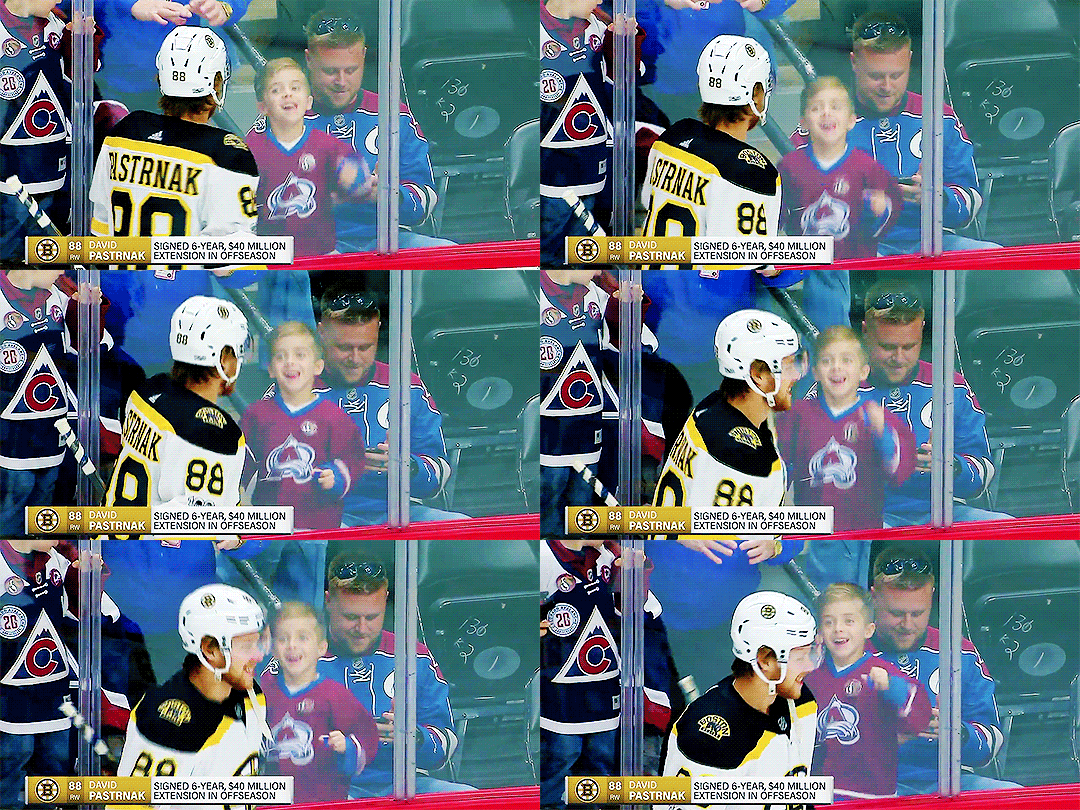
David Pastrnak is a talented, All-Star right winger for the Boston Bruins who won over the fans in Boston from day one for moments like this:


...and for moments like this:


Pastrnak has developed into a tremendous hockey player. After joining the Bruins as an 18-year-old, he had two modest seasons, then broke out for two consecutive 30-goal seasons. This year, Pasta started out like a house afire, scoring seven goals in Boston's first five games of the season. He reached the ten goal mark after nine games, and had 17 goals in the first 18 games of the season. Pretty astounding!

But Pasta cooled off. The next ten games saw him score just three goals. It took another ten games to get his next three goals. And it's taken seven to get the next three. Currently, Pastrnak has 26 goals in 45 games on the year, an impressive total that has Pastrnak tied for 7th in the League in goals, out of almost 600 players.

Three goals in a 10-game span is an impressive stretch for the vast majority of NHL players; to do so over the course of a season leads to a solid, respectable 20+ goal season. While Bruins fans know Pasta is not going to score every single game, the hope that Pasta would provide Boston with its first 50-goal player since the days of Cam Neely dim a little with each game--though we also know that Pasta is capable of going on a hot streak and scoring, say, seven goals in five games, or 17 in 18.

Slumps happen. Top-tier goal scorers go through periods where, to paraphrase the late, great Bill Chadwick, they couldn't shoot the puck in the ocean from the end of a dock. Goaltenders spring leaks. It happens. The players keep working, and if the slump gets bad enough, they do crazy things, like change how they tape their sticks, or find a new pre-game meal or stop shaving or start shaving or wash the lucky socks. Eventually, the puck starts (or stops, if you're a goalie) going in, and everyone: the player, his teammates, the fans, are happy again.

I write about this because I am, perhaps for the first time since I started seriously writing, going through a slump. Yeah, I'm sure if I dug through the archives of this blog, I could find posts where I whine and moan about being in a slump, but this one feels different. Way different. I think I wrote somewhere around Thanksgiving that I had resurrected an old project, and it was kind of, sort of going well. Now, it's not. While I was home for 2+ weeks at Christmas, I wrote almost nothing. I would sit at the computer, stare at the screen, and type around things, if you know what I mean. No scenes. No characters. No sense of what comes next from where I was in the story. And in the two weeks since I've been back at work? I've written absolutely nothing, at least on this story (I did go back last week and rewrote an opening scene from some other, long-dead project of mine, but that, too, seems to be going nowhere).

Back when I used to participate in the Absolute Write forums, I would generally respond to people who would complain of slumps or block or uncertainty to "write through it" or "just write it." Got a scene that is really sticky? Write through it. Not sure if your hero should use the gun or not? Just write it--both ways. You'll figure it out. I still think it's generally good advice. The act of writing, of pulling words, sentences, scenes out of your head and onto a page, though it feels draining, also leads to filling. It leaves room for more ideas.The problem is, when I sit at the keyboard these last few weeks, there just doesn't seem to be anything there at all to work with. It's a bit disheartening, to say the least.

David Pastrnak might try to bust a slump by changing the color of tape on his stick, or finding a new lucky sweater. Maybe I need to try an outline. Or different writing music (or none at all). Or clean up my workstation. I'm willing to take ideas. What do you do to bust out of a writing slump?


Monday, November 13, 2017

Delayed Reaction

On the afternoon of Sunday, May 4, 1974 the Boston Bruins and the Philadelphia Flyers squared off for game six of the Stanley Cup Final. For the Bruins, a win was needed to send the series back to Boston for one more, winner-take-all game. A Flyers victory would give them the Cup right there. Eight-year-old me sat on the edge of my couch, urging my beloved Bruins on. This was the Big Bad Bruins, the team of legends that included Esposito and Bucyk, Hodge and Cashman. And, most of all, Bobby Orr, my sports hero.

Late in the first period, Philadelphia's Rick MacLeish got his stick in the way of a shot and redirected it past Boston goalie, Gilles Gilbert. It would be the only goal in an entertaining, fast-paced game. The game ended in a 1-0 victory for the Flyers, and Flyers' captain Bobby Clarke lifted the Stanley Cup at center ice.

Is it too late to get this play reviewed?
Looks like goalie interference to me!
Eight-year-old me had been known to flip over a board game or two in response to losing (True Confession time: adult me has also flipped over a board game or two, as my friends who played Strat-O-Matic hockey and baseball can attest), but there were no tears. Disappointment, yes, but tears? No. Instead, I went out into a fine May afternoon and played hockey at the top of the driveway, where I fired tennis balls at the side of the shed, body-checked the house, and waged pitched 'puck battles' with the coiled up garden hose. I also suspect I altered history and scored a couple of goals for the Bruins, turning a 1-0 loss into a 2-1, sudden death overtime victory, followed by a game 7 win, but I can't say for sure. My memory is not quite that clear.

On the outside, not much had changed. I didn't swear off hockey like my father did on a regular basis (I think swearing off hockey was something common to New York Rangers fans back in the 70s and 80s). Yet, as I look back on it now, something definitely changed, because for the next three years, hockey was an insignificant blip, mere background noise in my life. I was aware of the biggest news of the day--the Bruins and Rangers pulling off an unthinkable, monster trade; Bobby Orr going to Chicago; the Islanders shocking the Rangers in the first round of the playoffs and setting the stage for the last great dynasty of the NHL--but it meant little. I still played hockey, quite passionately; but I stopped consuming the professional game for about three years. It's almost as if I suffered some sort of delayed action, sports-related post-traumatic stress disorder.*

I bring all this up because I've sent my RiP off to Carrie (True Confession time #2: I haven't. Yet. But by the time you read this, it will be in her inbox). Last year, this project actually gathered interest from an editor. It had me on pins and needles for two months or so while it worked it's way through the publishing house acquisitions project before it got rejected. Despite the rejection, I felt good about it. Really good. Someone had liked my manuscript enough to champion it in their publishing house! When Carrie and I conferred afterwards, she emphasized this fact and I assured her that I was disappointed, yes, but positive. I'd tinker with the manuscript and we'd try to get it back to this editor, hope that they would bite the second time around.

It didn't quite work out that way. What I submitted to Carrie last fall was, honestly, kind of rushed. We discussed it again around Christmas, and I received more notes from her and vowed to get to work on it immediately in 2017--and didn't. My excuse? Well, there was the lure of the shiny, but it was more than that. When I finished my first rough draft on the WiP and turned my attention back to the RiP, I dillied. And dallied. And dragged my feet. It's only now that I look back that I see the parallels between this fifty-something year-old writer and that eight-year-old hockey fan. Instead of sports-related PTSD, I think I have rejection-related PTSD. Both intellectually and in my heart there's no doubt this rejection was a positive thing, but deep down in my gut there's a defensive reaction to it, an involuntary hardening of the mental muscle to protect against another blow.

There is good news here, however. By 1977 I was back to watching hockey and passionately rooting for my Bruins, and I haven't stopped despite years of frustration: too many men on the ice, Steve Penney, Patrick Roy, Joel Ward, seventeen seconds. The Bruins have broken my sports heart many, many times over the last forty years, yet I still sit down to watch them. Last year's rejection at the editorial stage was my first. It hurt, more than I was willing to acknowledge at the time. But just as I kept playing hockey then, I kept writing. And just as I got past that 1-0 loss, I'm past the first rejection now. I may never get a rejection again. I may never even get a sniff from an editor again. But I'm going to be in the game.


*NOTE: Though I'm using a PTSD analogy here, let's be clear: a Stanley Cup loss or an editorial rejection is nowhere near equivalent to what so many people face as a result of traumatic experiences.


Monday, October 9, 2017

Sorry to see you go, Tom

I don't remember exactly when I first heard Tom Petty & the Heartbreakers. I do remember back in junior high school, having an acquaintance who was fast on the way to becoming one of my closest friends talking Petty up enthusiastically--along with other bands I had not yet heard of, like Elvis Costello, The Pretenders, and Rockpile. Shortly thereafter, I was walking around with the organ riff from "Don't Do Me Like That" on auto-play in my head.

I was not a fan the way my friend was--is, but I certainly liked what I heard. I saw Petty for the first time at Madison Square Garden in the mid-80s, backing Bob Dylan. The Petty & the Heartbreakers segment of the show was miles above the Dylan segment. (though Petty had certain vocal stylings similar to Dylan--hello, singing through the nose--the key difference was that Petty sang so you could understand him. Dylan almost seemed to go out of his way to be incomprehensible.) I didn't see him in concert again for more than twenty years, by which time the band was (incredibly) past thirty. And while the show never felt like some tired, "We're in it for the money here's a bunch of oldies for ya" thing (the band was promoting a new album at the time and played four songs from it during the set), you knew every song. And they were all good.

After forty years, Petty was apparently planning to call it quits on the major touring and was looking forward to spending more time with the family and doing...well, whatever it is rock stars do when they 'retire'. This usually involves a quiet period followed by an unexpected album and tour. Sadly, we'll never get to see that. Thanks for the memories and music (and those goofy appearances on It's Garry Shandling's Show).


In Other News...

Yes, I'm going to get political. The Trump administration continues using "religious freedom" as cover for its assault  on "others." Last week saw the announcement of new rules allowing employers to not offer contraceptives/birth control as part of health insurance based on religious or moral objections. Never mind that this impacts some 55 million women, and will likely result in a huge uptick in unplanned pregnancies and abortions (at least until the GOP finds a way to overturn Roe v. Wade and brings us one step closer to the Christian Sharia they seem to crave). Meanwhile, last week the Department of Justice has taken the position that civil rights laws don't apply to transgender people from discrimination at work.Now, this would be fine if  the DOJ's position was that Congress should take action to extend that protection, but what's the likelihood of that? And what's the likelihood that this Congress would do such a thing? Yeah, that's what I thought.

And, still sticking with politics--in the wake of the horror in Las Vegas this week, I have come up with a way to actually get something done on gun control: convince Trump that the second amendment was written by Obama. You'd see an instantaneous shift in the meaning of "Repeal and Replace."

Happier News...

Louie DeBrusk was a high energy, low-skill player in the NHL whose best season saw him score eight goals for the Edmonton Oilers in 1992-93. What endeared him to fans wasn't the 24 goals he scored in 401 games, it was his willingness to fight. DeBrusk racked up 1161 penalty minutes in his career, fighting 214 times.

Jake DeBrusk is Louie's son. He is not his father. A highly skilled player taken in the first round of the 2015 draft, Jake made his NHL debut with Boston on Thursday night, and provides a feel-good moment in a week that desperately needed feel-good moments (stick with the video):


A priceless moment.

One last bit of hockey news for my Australian reader(s): On Saturday night, Nathan Walker became the first Australian to play in the National Hockey League--and soon thereafter he became the first Australian to score a goal in the National Hockey League! Congratulations to Nathan! [EDIT] I meant to include this, but forgot: the Australian Ambassador to the United States is...Joe Hockey. No kidding!

That's all I got. Let's hope this is a better week. How are you all?

Monday, June 12, 2017

Monday Musing: No Real Theme Edition (and no political commentary!)

Random bits and pieces from over the last week, because I've been too lazy/busy to get an actual post!

-Penguins won the Stanley Cup last night. This was a good game, an entertaining series, and a lot more fun to watch in some ways without a dog in the fight. Congratulations to Pittsburgh on the win, and Nashville on a great series.

-In an era where coaching and systems have become so dominant, it's comforting to see talent as the deciding factor. Though the deciding goal wasn't some sort of rink-length, dipsy-doodling rush finished off with a diving backhander tucked up under the crossbar, Pittsburgh's overall talent superiority was evident in them having most of the really good scoring chances. It would be nice to see coaches fill out the bottom six forward lines with more talent over "grit," because the talent is out there.

-A couple of weeks back, I joined a Massive Online Open Course (MOOC; I think that's what the letters stand for) through the University of Iowa. The theme of the course is "Writing Identities and Social Issues in Fiction and Nonfiction" (I always want to hyphenate 'nonfiction'). It's been pretty interesting, good food for thought, good exposure to other writers. The 'discussions' we're supposed to be participating in, however, seem to be mostly individual responses to a question posed by an instructor instead of actual discussion. And there's a lot of quid pro quo critique going on. Of course, there are a lot of people in this course, with a lot of assignments being posted: how many can you read (and thoughtfully comment on) in a week?

-I used a piece of my WiP and a piece of my RiP for a couple of assignments and got some useful feedback. It also got me looking at my RiP, which means I'm actually one step closer to finally doing something with it.

-Downside of opening the windows to let cool night air in? Skunks. Last night, the smell just sort of wafted in, growing stronger and stronger, though it never quite reached eye-watering levels. Pepé le Pew was on the prowl!

-Hit the middle eighties yesterday. I think maybe we're clear of the threat of frost and snow--finally!

-Am I the only person who gets annoyed by this "Focused Inbox" thing that Microsoft is trying to shove down my throat with Outlook? Just show me everything and let me decide what's important, thank you very much.

That's about it for me, what's new with you?


Monday, May 8, 2017

Stanley Cup Favorites--Or Not


The National Hockey League playoffs are rolling along, more than halfway through round two. As I write this, eight teams have already been eliminated in the first round, one has been taken out of the second round, and another could be knocked out by ten thirty this evening. As always, the playoffs has provided drama, thrills and controversy in equal measure, heroes and goats, and further proof that no one really seems to know what goaltender interference is. 

My own Bruins went down in the first round, losing to Ottawa in six games, which means I can actually enjoy watching the games for a change (playoff hockey is probably the most excruciatingly exhilarating thing in the sports world. It's only when you don't have a dog in the fight that you can truly appreciate the game as a game.). Still, it's always more interesting when you're rooting for someone; I just need to figure out who. With that in mind, I'll list out the remaining teams, and some pros and cons of rooting for them. Maybe by the time I'm done, I'll know who to root for.

Anaheim Ducks

Pros: Well, uh, there's…hmm. Can I come back to this?

Cons: Ryan Kesler. Ryan Getzlaf. Corey Perry. The fact that the team, originally owned by Disney, was actually named after a movie franchise. Coach Randy Carlyle reminds me an awful lot of Dean Wormer. Maybe that's a pro?


Pros, part deux: Honestly, I still got nothing. As far as I can tell, the Ducks have no redeeming qualities at all. That was easy!

Edmonton Oilers

Pros: A Canadian team hasn't won the Stanley Cup since 1993. They practically invented the game, for God's sakes. Let 'em have one.

Cons: They switched to those awful orange jerseys. That's unforgivable. Sportscasters on Hockey Night in Canada insist on calling Ryan Nugent-Hopkins 'RNH.'

Nashville Predators

Pros: A Cup victory for P.K. Subban will give the management of the Montreal Canadiens an ulcer the size of Tycho. As a Bruins fan, anything that does that is fine by me (and I like Subban, now that he's not on Montreal anymore).

Cons: With 46 games played for the Predators, it's possible that Mike Ribeiro gets his name on the Cup.

New York Rangers

Throw it into Mount Doom, Master Mats!
Pros: A win means they can finally stop talking about Mark Messier and 1994. They were my Dad's favorite team, and I have a lot of friends and family who would be really happy if they won. Mats Zuccarello would be the first hobbit to get his name engraved on the Stanley Cup. 

Cons: New Yorkers are insufferable when their teams win championships. A deep playoff run means having to look at an ever-increasing number of bandwagon celebrities in the Madison Square Garden crowd.

Ottawa Senators

Pros: See Oilers, Edmonton. Also, the original Ottawa Senators won 11 Stanley Cups in the NHL's early days before moving to St. Louis and folding in 1935. As such, the Senators, who rejoined the NHL in 1992, would be the first "Zombie Team" to win the Cup. That'd be kind of cool. And we'd get two more rounds of Coach Guy Boucher doing stuff like this:


Cons: The Senators have a bunch of sneaky-dirty guys who are jerks. And not just because they eliminated the Bruins. Since the NHL is a league of copycats, a Senators Cup win might set the NHL back about 20 years, as everyone decides to employ a boring system with a bunch of marginally-talented players. We'd have two more rounds of Guy Boucher, and frankly, Guy Boucher scares the bejeebus out of me:


Pittsburgh Penguins

Pros: There hasn't been a back-to-back Cup champion since Detroit in 97 and 98; it's time we had one. A second consecutive Cup for Phil Kessel would be a giant "FU" to the Boston media who savaged him when he left the Bruins and might earn him some of the respect he deserves.

Cons: A third championship for Sidney Crosby would make listening to NBC coverage of the Penguins even more insufferable than it is now--and it's pretty insufferable.

Washington Capitals

Pros: A win for the Caps might just shut up some of the unfair criticism directed at Alex Ovechkin, who has only scored more goals by a long shot than anyone else since he entered the league. It would also mean Justin Williams is still perfect in his career in game 7s. They have a guy named Beagle--who doesn't like a beagle?

Cons: I still hate Braden Holtby for almost single-handedly knocking out the Bruins in 2012. Tom Wilson is a dangerous player who needs to stop leaping into hits. I'm not real happy with anything from Washington these days.

The verdict
 
Well, that was very helpful. As expected, writing all this out has helped me figure this out. So, who do I want to win the Stanley Cup now that the Bruins are out? Well, um...err...Bruins in 2018!

Can you root for anyone when your favorite team is out of the playoffs? How do you decide?

Monday, June 6, 2016

Monday Musing: No Real Theme

Starting is always the hardest part. Do I ease into the post with an introductory paragraph, or dive right in?

It's supposed to be fun. Over the last few weeks I've been reading Stacy McKitrick's agonizings over the Pittsburgh Penguins' playoff fortunes. She's up! She's down! She's up! She's down! (Today, she's down) And as I read it, I think, "Wait, isn't sports supposed to be fun?" 

This year for me was one of the most frustrating years I can recall, as my Bruins started out of the gate like a house Dumpster afire (and here's something that's got me thinking: why is "a house afire" good, while a "Dumpster fire" or "tire fire" is bad? Dumpster fires may stink, but at least it's getting rid of something we don't really want), then rocketed all the way to the top of the division and looked like a lock for the playoffs before sinking into a tarpit in March. I can't recall ever being more aggravated while watching this team, and on several occasions, I found myself thinking, "I can't watch this." Yet I always went back. Glutton for punishment.

For my part, I thought that the Pengins/Sharks game 3 was the best of the lot so far, the most even game from start to finish. We'll see what happens from here. Here's hoping for great hockey!

Here's to re-reading. Last night at dinner the subject of re-reading books came up, and my wife mentioned one (and now I can't remember what it was that touched this off, or which book it was) that was one of the few books she's ever re-read. She's not big on re-reading. For me, I re-read a lot, possibly more than I should. This weekend, I finished my third re-read of Robert Penn Warren's All The King's Men--and found that it just seems to get better each time.

I read it for the first time about eight years ago--it was a new edition, released in conjunction with a new film adaptation--and liked it. Probably three or four years I read it again and liked it more. Last week, having exhausted my supply of unread books for the moment, I grabbed it. Even better.

Still have no idea how it actually works!
It's tough to play video games (particularly the puzzle-type games) over and over again. Even if you let a lot of time pass between playings, all the things that made the game challenging the first time come back fairly fast. "Oh, I remember this, I have to do this to get in the door." Maybe it's the writer's mind at work here, but re-reading this book, I'd hit an event that would trigger a bit of memory: "Oh, right, this is going to happen to that character later on." Rather than spoil it, it was insight into how a master writer did things. It was a little like getting to look at the intricate inner workings of a Swiss watch. And it's beautifully written. Now let's see if I can learn anything from it.

Vindication! (sort of) Remember back when Frozen was still a thing, and I posted this? The Hans Heel Turn never sat right with me. Apparently, someone else feels the same way, and has gotten to the bottom of the whole thing. Here's an amusing--and eye-opening--read: "You Really Have No Idea Who The Villain of Frozen Is" (and be sure to read the photo captions in that article, too). Yeah, it's from Cracked, but still--it all makes sense now!


That's about all I've got for today; how about you?

 Image credit: Mechanism, by Alex Brown, used under Creative Commons license.

Monday, October 12, 2015

And Again...The Chestnut

Here in this corner of America, Memorial Day marks the start of summer, Labor Day the end. Yet Columbus Day is, in many ways, the real end of the tourist season (though to be fair, fall foliage is just peaking now, and then there's hunting season--but neither of those things really do a lot compared to the summer). With that in mind (and because, quite honestly, I just didn't have the brain power for a *real* post today), I bring you...the chestnut.

Four leaves this year!


Well, as you can see, this wasn't exactly a banner growing season for my little American chestnut. This was the last photo I posted, back in May, when it was just starting to bud. This is not a great picture, granted. The new main stem did not put a lot of growth on this year; perhaps an inch, if that. From what I understand, however, this may be the year. The little tree should have been putting most of its energy into the root system. Next year is the critical one. Next year, if all goes well, the energy put into the roots this year (and last, to some extent), should fuel a pretty big growth spurt. Let's hope so.

In other news, I'm happy to say I spent my Columbus Day doing a lot of writing, probably close to 5 hours total time between this morning and early afternoon. Sadly, I spent some time listening to the Bruins' game this afternoon, and that was a mistake. It's early in the season, but things are looking mighty grim for them right now. After the front office made some head-scratching moves this summer that left the team with questionable depth, especially on defense, the team got hit with three big injuries right out of the gate. I shall try not to be pessimistic.

I hope you all had a nice weekend! Anything interesting happen?

Friday, June 21, 2013

50 Ways....


Remember that old Paul Simon song, 50 Ways To Leave Your Lover? What's that, you don't? Oh, right, of course not, you're too young. Well, it was  a hit for Simon back in the mid-70s, which is why most of you DON'T remember it, but through the magic of the internet, you can see it here, if you so choose.

One person who probably does remember it is Hall of Fame broadcaster, Mike "Doc" Emrick, the current voice of the National Hockey League during the Stanley Cup Final. While he's not everyone's cup of tea, I've loved listening to Emrick since I first heard him calling games for ESPN back in the 90s. His love of the game is evident, and he's one of the most creative souls when it comes to describing the action.

Case in point: during Game 1 of the final between Chicago and Boston last week, Doc used no less than fifty (50!) words to describe a simple action that takes place hundreds of time during a game: the movement of the puck from one player to another, which is typically called "a pass." Someone kept a list, and here it is:


As outlandish as many of Doc's synonyms look on paper, they are frequently bang-on descriptions for the action. While I'm not entirely sure how you 'wand' a frozen disc of rubber, and 'spirits it' is a total head-scratcher, most of these really, really work in the course of the action. And this list is not inclusive; this is only what he used in game 1. Doc also has players 'shillelagh it' (knocking the puck out of the air), and one of my personal favorites is 'ladled it', which occurs when the puck is played softly down the ice.

I'm not sure what's more amazing, the fact that
a)      Doc has actually come up with so many words to describe a common action;
b)      Doc can actually remember to use these words appropriately while in the midst of describing what can be a ridiculously fast-paced game; or
c)      Someone actually sat down and made this list while the game was going on (I'm guessing the guy had no rooting interest in the game)

Point B is something all of us writers should take into consideration. We're always looking for new ways to say something, to set us apart from all the other writers out there. There are all kinds of interesting ways to say things, and it's our job to find them. BUT the key is to make the words sound natural, to fit them into the flow of our writing, to match them to the voices of our characters. 

Oh, and of course, someone did a "Doc Emrick 50 Words Mashup", which is a fun listen. Enjoy, have a great weekend!

Monday, June 3, 2013

Sports Narratives


Hey, a guy could get used to this.

Sitting back, cool, salt-tinged breeze, cold drink at hand—yeah, it would be easy to just send a postcard back that says, "You know, I've decided to stay. So long, and thanks for all the fish."

Of course, that ignores the fact that, within about three minutes of posting my, "I'm going to take a short break" message, I had an idea for a post. And then another, and another. It would ignore the fact that I came *this close* to posting on that first Monday of my little vacation, and that I almost posted on Friday of last week, too. Then I decided to make good on a promise made on this blog (for once), and stay out for the rest of the weekend.

This week, Lisa Regan's second novel, Aberration, is being released. To celebrate, Lisa is running The Aberration Blog Hop: Finding theMost Aberrant Characters on Thursday and Friday. Follow that link above to sign up. It's quite a tall task, winnowing the list down, as there are so many memorable, aberrant characters. I'm looking forward to it, and to reading Aberration.

Now, on to the business at hand. This post almost got put up on Friday, but like I said above, I decided to sacrifice timeliness for sanity. It's still timely, I guess. I just have to make a few changes.

If you're ever feeling insecure about the future of fiction, stop worrying. Worry about whether you can make a living as an author of novels, sure. Worry over whether you should seek publication via traditional means, or if you should join the growing ranks of self-publishers. Worry over how much the next wave of technology is going to change how we present our stories, if at all. Worry over whether or not your style is current enough, or whether readers will like you, but don't worry about fiction. Styles and tastes change, packaging and delivery change, but what doesn't change is our need for stories. People need stories, and as long as that's the case, we need people to write 'em.

For proof, look no further than the world of sports. Last week, while the Boston Bruins and Pittsburgh Penguins were waiting for their semifinal series to start, Puck Daddy, a Yahoo hockey blog, ran this story: Penguins Vs.Bruins: 10 must-watch storylines for the Eastern Conference Final. 

It's a typical sort of story that comes out at this time of year. As a Bruins fan who spends far too much time scanning online editions of Boston newspapers, I see this sort of thing all the time. Between all the sportswriters who have to fill column space and sell papers, bloggers trying to generate click-throughs, and TV talking heads who have to fill three-minute blocks between commercial breaks every night, there are stories about everything. And while it's a bit different than pure fiction, it doesn't feel that far off. Whether it's rehashing the details of how new-Bruin, Jaromir Jagr played on the Boston-beating Penguins in 1991 and 92 (yeah, he's that old, and yeah, it shows on the ice), or wondering if the Bruins are angry with Jarome Iginla for rejecting them at the trade deadline in favor of the Penguins, or if they're going to 'go after' Matt Cooke for his dirty hit of three years ago, or…or…or.

It's funny, isn't it? At this stage of the playoffs, we have the four best teams (and hey, the four remaining teams are the last four Stanley Cup winners—what a story!) playing great hockey. They're going at each other at least four times, every other day. The action is intense, the stakes are high. There may be more drama in the 'one-and-done' style of the NFL or the NCAA tournament, but for a physical, high speed sport like hockey, the series format ratchets everything up another notch. Hockey goes to eleven, to borrow a phrase. The biggest story should be what happens on the ice each night, not how player X was almost traded to team B. It should be enough. And yet, here we are, manufacturing stories, magnifying the importance of this, that and the other thing. I think it says a lot about us, and the future of writing. Writers will always be needed. Storytellers will always be needed. Let the sociologists, anthropologists, and whateverotherologists who study this sort of thing tell us why, because I sure don't know; I'm going to settle down and watch a hell of a story unfold.

Monday, January 14, 2013

Monday Musing: The Lockout is Over


And so it's officially over.

The members of NHL Players' Association have ratified the new collective bargaining agreement, officially bringing to a close the second lockout in eight years, and the third overall in the tenure of NHL Commissioner Gary Bettman. The deal followed some intense negotiation, which followed weeks of negotiation, non-negotiation, and gamesmanship aimed at painting the other guys as the bad guys in the fight. I'm happy it's over. While hockey never went away, the truth is the alternatives to the NHL--the American Hockey League, college hockey, Russia's KHL--just can't compete. The NHL is indeed where the best players of the world go to play. I'm happy it's over, I'll watch the games, but I honestly haven't missed it quite as much as I thought.

Anyway, it's amazing how so little can get done for so long, and then it all rushes together. With the cancellation of an entire season looming (for the second time), owners and players finally felt the economic pinch. And in the case of the players, I'm sure they were also well-aware of the ticking clock, the one that accompanies professional athletes in any sport. A year lost to a labor dispute is not just a lost year's salary, it's a lost opportunity to play the sport you love, to live out your dream. Unlike those of us who are school teachers, CPAs, or car wash attendants, professional athletes have a small window for achieving fame and fortune. Niclas Lidstrom, Chris Chelios, Gordie Howe and Johnny Bucyk—players who all played for 20+ years—are rare in the sport. According to Quanthockey.com, the average NHLcareer lasts 5 seasons, roughly 20% of retired players played in only one season, and for many former players, their first NHL game was also their last. While money was clearly an issue, the fact is, it's not the only issue. 

Think about that for a second. A five-year career. If you knew you only had five years to write a great book, or as many great books as possible, would it change your approach to writing? I bet we'd all spend a lot less time blogging and surfing forums and so on and so forth.

Yikes. Sorry to come off sounding like such a downer. I actually started off feeling pretty good today. So, let's just toss this in there to make me feel better, one of the great ads the NHL did a few years ago (and, oh the irony of having Youtube stick an ad in front of an ad). Have a great week, all.


Friday, April 20, 2012

Casual Misogyny


On April Fools' Day, appropriately enough, I watched the Pittsburgh Penguins and Philadelphia Flyers square off in a heated late-season game with playoff implications. It got ugly, to the point where Flyers coach, Peter Laviolette (in the orange box) had to be restrained by his assistant, Craig Berube (and if you watched Berube play, you know how ironic it is that he's holding anyone back). The object of his ire was Dan Bylsma, Pittsburgh's coach. Bylsma, in the blue box, remained behind the bench, safely protected by Tony Granato, who is standing on the boards opposite Laviolette.

Late game shenanigans is not unusual between these two teams, especially not when they're looking at a first round playoff matchup starting in a week. Messages have to be sent, after all. The unusual thing was what NBC Sports personality Mike Milbury said the next day:

"I thought Dan Bylsma should have taken off his skirt and gone over there."

Actually, this is not that unusual, not for Milbury, not for the sports world. Milbury was a hard-nosed player, and he's an emotional guy with strong opinions who gets easily wound up, which is part of why he gets paid (probably handsomely) by NBC. He's clumsy and awkward when asked to analyze a defensive zone breakdown that leads to a goal, but he's fun when asked about officiating, or a suspension, or a team reacted to the rough stuff. This year, with the league supposedly cracking down on hits to the head and dangerous hits from behind, Milbury railed against the "pansification" and "wussification" of the league. Yes, he really did use those words on air. During last year's Stanley Cup final he referred to Vancouver's Daniel and Henrik Sedin as "Thelma and Louise" because they didn't fight back when the Bruins roughed them up (and this shows how much Milbury knows about Thelma and Louise – if Brad Marchand had tried this on either Thelma or Louise, they would have taken care of him, big time). I'm also pretty sure I've heard him refer to Daniel and Henrik as 'The Sedin Sisters', an insult which is more commonly heard in sports bars and read in the comments section of hockey blogs, where everyone also insists on calling Penguins superstar Sidney Crosby "Cindy" (hey, Carrie did that on Monday, didn't she?).
 
Milbury's statements started something ticking in my head. And a week or so later, the ticking got louder, courtesy of the the Washington Capitals-centric hockey blog, Russian Machine Never Breaks. They created an NBC Bingo game for the first game of the Caps-Bruins series. Note that one square in the top row: Casual Misogyny. If it's getting a square on the Bingo board, it must be getting some serious air, and I started to wonder about it. By the way, that's Milbury in the middle, the free square.


We might be able to excuse Milbury. He's a polarizing figure, paid more for his opinions than for analysis. The interview where he called out Bylsma was for a Philadelphia-area radio station, and I wouldn't be at all surprised to learn that he was at least in part playing to his audience. But can we forgive this item that came from The Chicago Tribune two years ago, when the Blackhawks played the Flyers in the Cup final?


Is this appropriate journalism? I'm sure the editors would say "It's all in fun" but what message is it sending, and to whom? Calling opponents girly names is a long-standing tradition in sports. These are things that are often said in the heat of battle on the field, ice or court, and I doubt it bothers most of the players. I'm pretty sure Chris Pronger laughed this off when he saw it. When I played sports, it never bothered me. But when sports journalists throw this stuff around so easily, I have to wonder how it effects women and girls.
 
Well, maybe I got a hint of this. Last week, Puck Daddy  pointed me to this post on The Active Stick. This is the blog of a female hockey fan, and here's what she had to say about this:

If you’re a woman, and you call him Cindy Crosby, or you call them the Sedin Sisters … do you know what you’re doing? You are calling someone female to insult them. You are using yourself as an insult. Have a little more respect for yourself.
If you’re a man, and you make Cindy/Sedin Sisters jokes at me to make me laugh, do you know what you are doing? You are using me as an insult. Why would I find that funny?
For another opinion, I went to The Wife. She wasn't too fazed by any of it, and is of the opinion that some people are maybe too sensitive. And that pretty well jibes with my own feelings – I think, quite often, there are people out there who are looking to be offended, and that we should all have a little more sense of humor. But then again, I have to consider this: I am a man. I am a white man. And I'm not especially religious. It's easy, being in my position, to say, "Eh, so what? Laugh it off." But at the same time, I think maybe it's time to bring this sort of thing under control. Maybe it's time to put a stop to it.

I've gone on too long for today. Next week I will actually look at a writing connection to this. In the meantime, I'd really like to hear what all of you have to say. I know most of my followers are female, so let me ask you: Do you think the Casual Misogyny tossed around by Mike Milbury (and others; I don't mean to pick on Milbury, I actually like him) is something to shrug off, or is it a real problem? All opinions are welcome, I just ask that you keep it civil (which I don't expect to be a problem). Have a great weekend, and thanks for stopping by and sharing.